

The fastest way to turn AI cost governance into a political fight is to charge teams for a pooled number they do not trust.
One large API invoice is divided across departments using an allocation rule. Teams dispute the keys, the shared platform cost, the model choices, and the invoice itself. The meeting becomes an accounting defense rather than an operating review.
There is a better first move: showback.
What chargeback asks too early
Chargeback moves cost into a team’s budget. That can create accountability when the consumption is attributable, the allocation method is accepted, and the owner has authority to change the underlying behavior.
AI spend often fails all three conditions.
Model endpoints are shared. Workflows cross teams. SaaS vendors embed AI in seat licenses and usage charges. Agents call multiple models and tools. One interaction can create consumption in several systems.
If the recipient cannot explain or influence the number, charging it creates resistance rather than ownership.
What a useful showback report contains
Start by showing each material workflow and owner five things:
Fully loaded AI cost
Units of work attempted
Successful outcomes
Cost per successful outcome
Trend and material exceptions
Cost alone can shame the team doing the most valuable work.
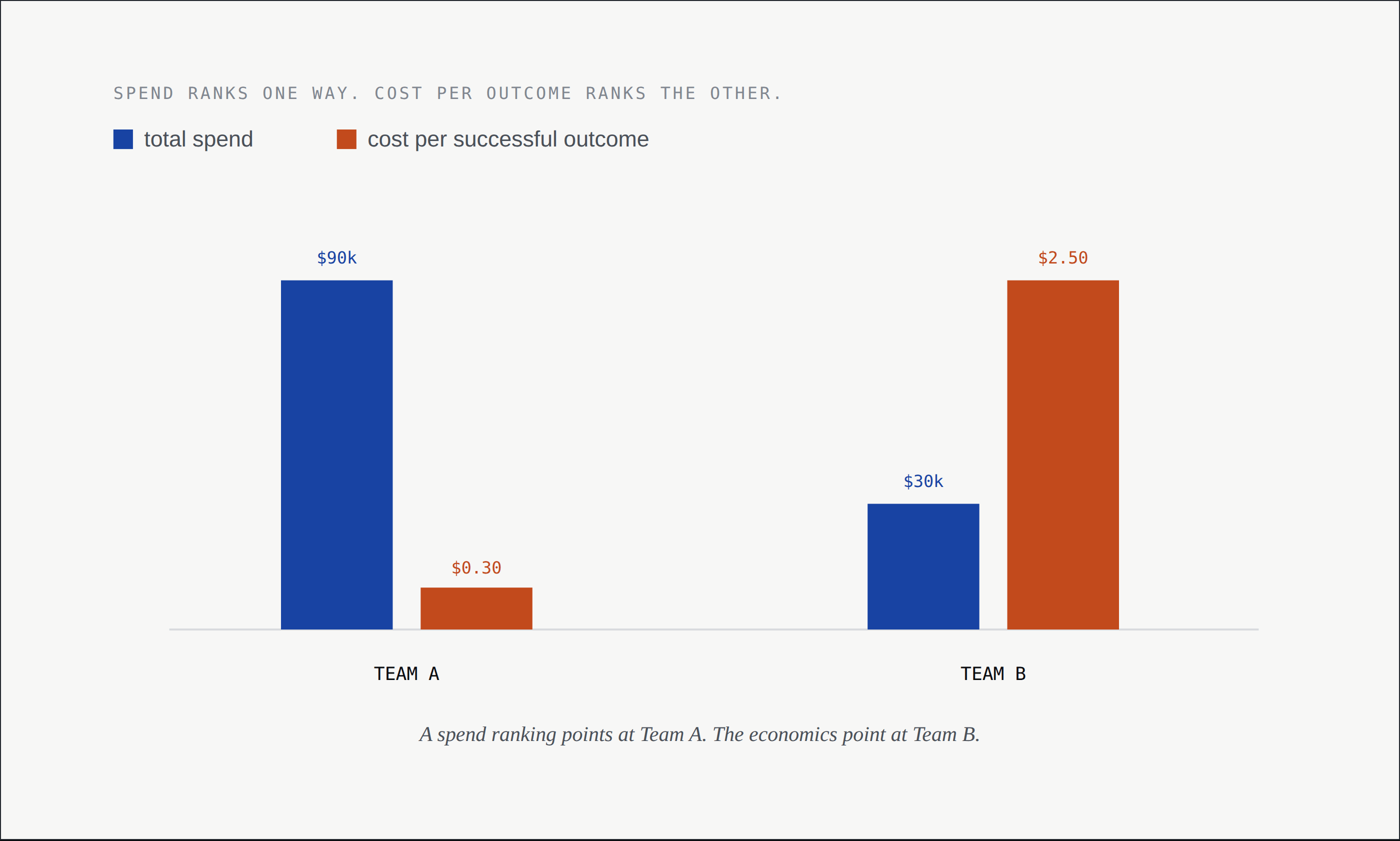
Imagine two workflows. Team A spends $90,000 and produces 300,000 successful outcomes. Team B spends $30,000 and produces 12,000.
Team A is the largest spender at $0.30 per successful outcome. Team B spends less in total but costs $2.50 per outcome.
A spend ranking points at Team A. An outcome-weighted showback points leadership toward the economics.
Showback is an operating conversation
The report should land with a named person who can answer four questions:
What caused the spend?
What did the workflow produce?
Why did the ratio move?
Which decision will the owner make next?
Run the view for two or three cycles before deciding whether chargeback will improve behavior. Use that period to correct attribution errors, resolve shared-cost disputes, and establish which owners can actually change model, workflow, or volume decisions.
The showback process is working when the conversation changes. Teams stop asking whether the invoice is fair and begin asking why one workflow’s cost per outcome is rising.
When chargeback becomes useful
Chargeback can be appropriate after the underlying conditions mature.
The cost should be attributable enough to defend, the allocation method should be understood, and the recipient should have authority over the decisions that create the cost. A team charged for model consumption needs the ability to change its model, routing, workflow, or volume. Otherwise the charge is an accounting transfer without a management lever.
Showback is therefore not a softer substitute forever. It is the proving period that tells leadership whether chargeback will create accountability or merely redistribute an argument.
Trust is the operating prerequisite.
Some AI cost should never graduate to chargeback at all. A shared foundation-model endpoint that every team calls, a common evaluation harness, a central safety and monitoring layer: these are utilities. Splitting them across teams by an allocation key manufactures an argument without changing any decision, because no single team can act on the number. Fund and manage them centrally, the way an organization funds the network or identity, and charge back only the consumption a team can actually control.
Reallocation is the point
The purpose of the report is not internal accounting elegance. It is better capital allocation.
Move budget toward work that produces valuable outcomes efficiently. Move it away from work that buys little, cannot define success, or keeps its failure outside the report.
That decision may increase total AI spend. A growing workflow with strong outcome economics can deserve more funding. A small, inexpensive experiment can deserve closure if it produces nothing the business values.
This is why showback should include outcome before chargeback introduces a price signal.
Chargeback moves money.
Showback creates the trusted information needed to move it intelligently.
A question for readers
What prevents credible AI showback in your organization today: attribution, outcome definition, ownership, or shared-cost allocation?
Onward,
Raja
Raja Pabba is the founder of CloudMetrics and writes The CAIO Review on enterprise AI operating discipline. Subscribe at caioreview.com.