

The vendor sends a bill in tokens. The board asks what the company received.
Nothing connects those two automatically.
That gap is why so many AI ROI discussions become arguments between precise cost and ambitious narrative. The spend is documented to the cent. The value appears as a large estimate on the final slide. The chain between them remains implicit.
The two sides that rarely meet
Finance can usually tell you what a technology system costs: software, infrastructure, people, implementation, and support.
The business can usually describe the outcome it wants: faster service, lower operating cost, more revenue, less risk, or freed capacity.
Historically, those views met poorly. Technology cost climbed to the application and stopped. Business value descended to the outcome and stopped. The cost of the system and the value of the business process lived in different ledgers.
AI forces the ledgers closer because AI consumption increasingly attaches to units of work. A model reads the document, drafts the response, routes the case, or attempts the decision. The organization can no longer rely on application cost as a reasonable proxy for outcome cost.
A worked crossing
Take a stylized support program with a fully loaded monthly cost of $120,000.
It produces 48,000 verified resolutions.
The first useful ratio is:
$120,000 ÷ 48,000 = $2.50 per verified resolution
Now assume finance accepts that each verified resolution avoids $8 of service cost compared with the agreed baseline.
The accepted monthly business effect is:
48,000 × $8 = $384,000
The resulting ratio is:
$384,000 ÷ $120,000 = $3.20 of accepted effect per dollar spent
The calculation is simple. The work sits inside the definitions.
If the 48,000 resolutions were never verified, the chain breaks.
If the $8 is a hopeful estimate rather than a finance-approved counterfactual, the chain breaks.
If the $120,000 excludes human review, evaluation, data, platform, or support cost, the chain breaks.
The ratio does not end the debate. It shows everyone where the debate belongs.
The complete chain
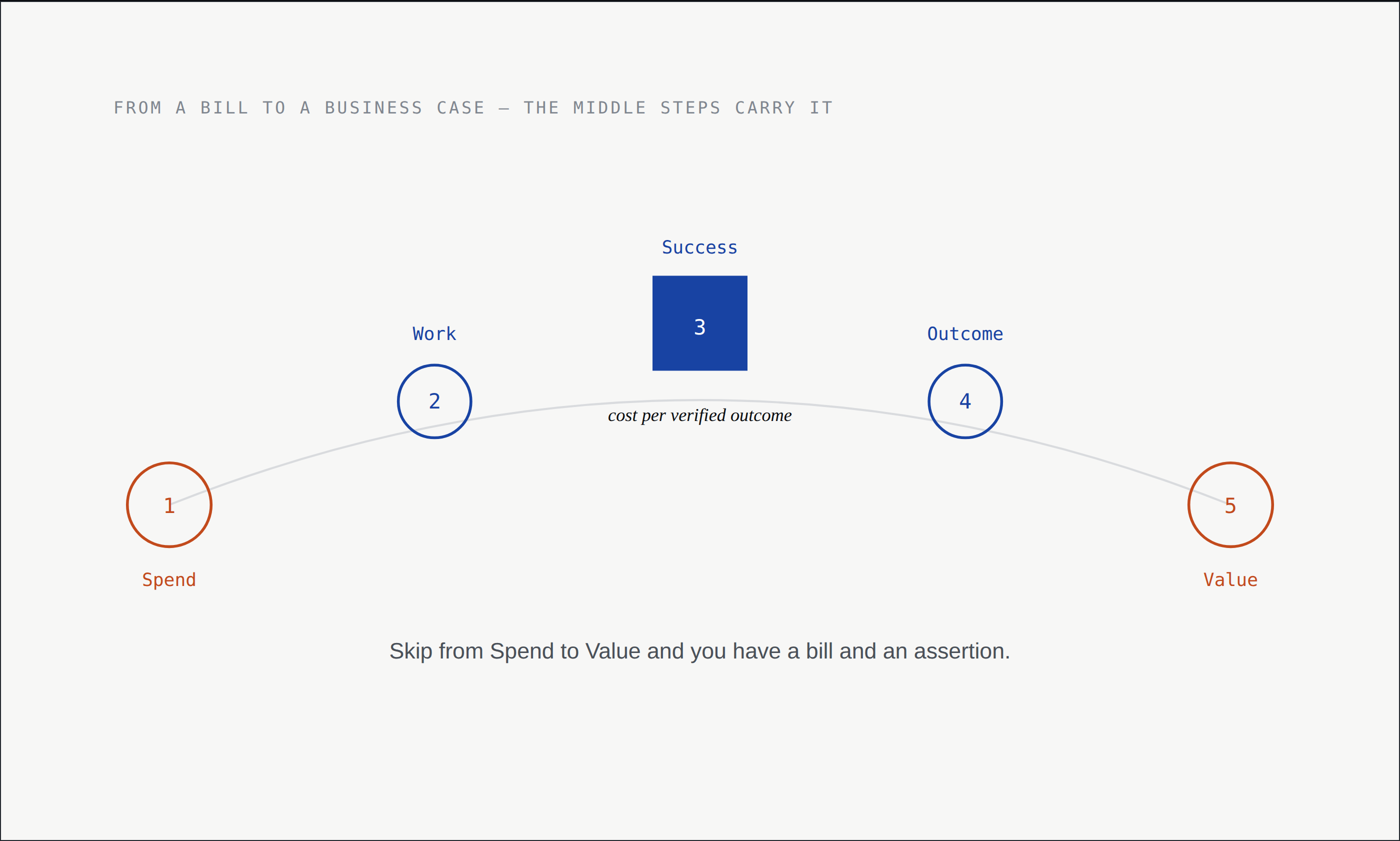
A defensible AI value case moves through five questions:
Spend: What is the fully loaded cost?
Work: What did the AI attempt?
Success: What completed correctly under an agreed definition?
Outcome: What business event occurred?
Value: Where did that event affect revenue, cost, capital, or risk?
Skipping from Step 1 to Step 5 produces a bill and an assertion.
The middle steps are where attribution, verification, and credibility are built.
Where value can land
For executive review, every value claim should name its destination.
Revenue gained
Operating cost avoided
Capital or capacity freed
Risk reduced, with an accepted valuation method
“Productivity” is too broad until it lands in one of those places. Time saved is not automatically cost removed. Capacity created is not automatically revenue gained. The P&L effect needs an owner, an agreed baseline, and a mechanism.
That discipline can reduce the size of the value claim. It also makes the remaining claim far more useful.
Treat avoided cost carefully
Avoided cost is often the largest line in an AI business case and the least tested. If employees save ten minutes, the company has created capacity. It has not necessarily removed expense. The economic effect depends on what happens to that capacity next.
Finance should distinguish among cash removed, future hiring avoided, service volume absorbed, and time made available for other work. Each can be valuable. They belong to different claims and should not be added together casually.
Naming the destination protects the business case from counting the same benefit twice.
Build the counterfactual
Every value claim rests on a comparison: the outcome with AI against the outcome without it. That second number is the counterfactual, and it is where most AI business cases quietly fail. The $8 saved per resolution means nothing until the baseline it is measured against is defined and agreed.
A defensible counterfactual states four things. What the process cost before, measured the same way the new process is measured. What volume it handled, so the comparison is normalized rather than flattered by growth. Which period is being compared, named explicitly, so a seasonal low is not read as a saving. And who in finance agreed to it, because a baseline the business sets for itself is a marketing number.
The counterfactual is also perishable. A model that saves $8 against last year’s manual process may save far less against this year’s improved one, because the organization would have gotten better anyway. The honest baseline tracks the business as it changes, rather than a frozen past that makes the AI look good.
When the counterfactual cannot be established, the correct move is not to invent one. It is to report the verified outcome and the fully loaded cost, and to hold the value claim open until finance can agree the comparison.
The executive question
When an AI ROI deck presents a large value number, ask the team to show the bridge:
Which verified outcomes produced that value, and which fully loaded costs produced those outcomes?
The answer is the business case.
A question for readers
Where does your organization’s AI value chain usually break: full cost, verified outcome, counterfactual, or P&L attribution?
Onward,
Raja
Raja Pabba is the founder of CloudMetrics and writes The CAIO Review on enterprise AI operating discipline. Subscribe at caioreview.com.