

An AI usage chart can be perfectly accurate and still tell leadership almost nothing.
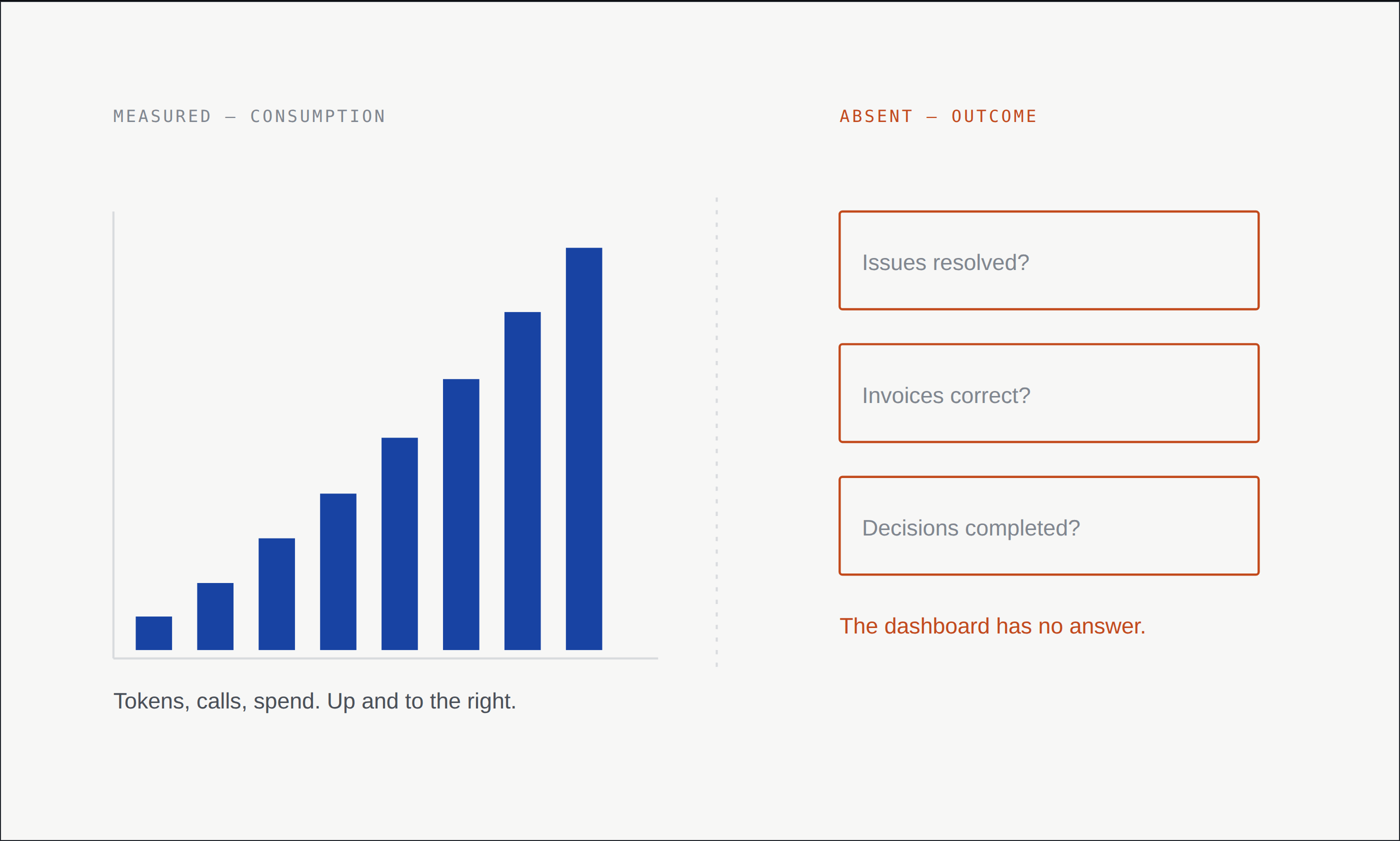
Tokens per day are rising. Calls are rising. Spend is rising. The line is clean, the data is current, and adoption appears healthy.
Then someone asks a different question: How many customer issues were resolved? How many invoices were processed correctly? How many decisions were completed without escalation?
The dashboard has no answer.
This is the first mistake in AI cost management. Organizations take the number the vendor supplies most easily and promote it into the number the business manages.
The reason is an asymmetry that runs through the whole subject. The cost number is metered by the seller. It arrives automatically, for free, to several decimal places. The value number has to be built by the buyer, from work only the buyer can see, and it is contested at every step. Given a free precise number and a costly contested one, organizations manage the free one. Tokenmaxxing is what that choice looks like on a chart.
What a token actually tells you
A token is a legitimate unit of consumption. It tells you how much text a model processed or produced. It belongs on the invoice, in the engineering console, and in capacity planning.
It does not tell you whether a unit of work finished, whether the result was correct, whether a human had to repair it, or whether the outcome was worth anything.
More tokens can mean more useful work. They can also mean longer prompts, repeated retries, wandering agents, unnecessary context, and failures that eventually land with a person.
The ambiguity matters because opposite operating conditions can produce the same usage chart. One team may be serving twice as many customers. Another may be spending twice as much to complete the same work. At the token layer, both lines point upward.
The vanity-metric pattern
We have seen this pattern before.
Lines of code became a proxy for engineering productivity. Billable hours became a proxy for client value. Story points became a proxy for delivery. Each number began as a useful measure of activity. Trouble arrived when the proxy became the target.
Once activity becomes the target, activity grows.
I call the AI version tokenmaxxing: treating rising token consumption as evidence that an AI program is progressing.
The behavior can look sophisticated. Teams segment tokens by model, application, feature, and business unit. They forecast consumption precisely. They negotiate a better rate per million. Every one of those activities can improve cost discipline.
None of them answers whether the AI work succeeded.
The denominator is missing
The useful number is rarely total tokens. It is cost divided by something the business recognizes:
Cost per claim settled correctly
Cost per invoice processed without exception
Cost per customer issue resolved and kept closed
Cost per contract reviewed to an accepted standard
That denominator changes the conversation. A model that appears expensive per call may be cheaper per successful outcome because it produces fewer retries and escalations. A workflow with rapidly growing token use may deserve more budget because it is producing valuable work efficiently. A low-consumption workflow may be the wasteful one if it rarely finishes successfully.
The first move is therefore simple. Keep the token meter, then place one operational number beside it:
What unit of work did the AI attempt?
How many units finished?
How many met the agreed definition of success?
What was the fully loaded cost per successful unit?
The first version will be rough. That is acceptable. A rough connection to the work is more useful than another decimal place on consumption.
The executive question
The next time an AI dashboard shows tokens up and to the right, resist the urge to read growth into the line.
Ask one question:
What did those tokens finish successfully?
If the report stops at consumption, it is a usage meter. Management begins one rung higher.
A question for readers
What is the most misleading activity metric you have seen presented as AI progress?
Onward,
Raja
Raja Pabba is the founder of CloudMetrics and writes The CAIO Review on enterprise AI operating discipline. Subscribe at caioreview.com.