

The AI cost decision with the most impact often happens before model selection.
It is the decision to use the smallest reliable mechanism that can produce the required outcome.
Teams frequently begin one step too late. They ask which model to use before asking whether the work requires a model at all.
The frontier-model reflex
The most capable tool is easy to justify. It handles messy inputs, generates impressive demonstrations, and creates room for the use case to expand.
That flexibility also introduces a cost surface: model consumption, latency, variability, evaluation, monitoring, failure handling, and often human oversight.
For work that genuinely needs judgment, language, or open-ended reasoning, those costs may be justified.
For deterministic work, the organization can end up paying a premium for variability it did not need.
The AI Minimalism Ladder
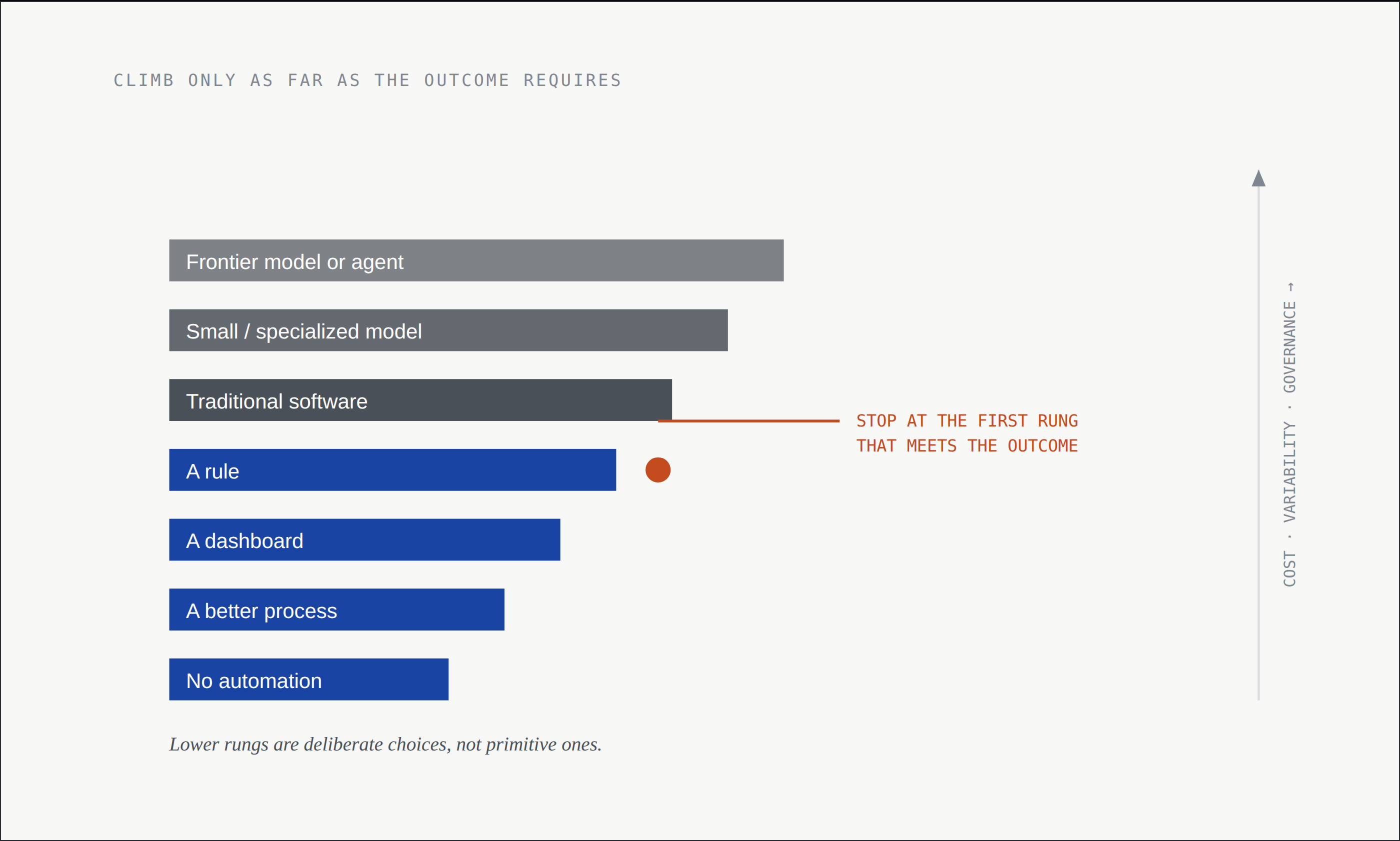
Start at the bottom and climb only as far as the outcome requires:
No automation
A better process
A dashboard
A rule
Traditional software
A small or specialized model
A frontier model or agent
The lower rungs are not technologically inferior. They are preferable when they solve the problem reliably with less cost and less operating burden.
A rules engine can be the sophisticated choice when the task is bounded and auditable. A database query can outperform a model when the answer already exists in structured data. A process change can remove work that automation would merely execute faster.
Let the outcome set the rung
The decision should begin with the task’s Success Signature.
If the outcome is machine-verifiable, immediate, fully observable, and governed by stable logic, a lower rung may be enough.
If the work depends on ambiguous language, contextual judgment, or input variation that cannot be enumerated in advance, a model earns its place.
Even then, the organization should distinguish between a small specialized model and a frontier model wrapped in tools and human review.
The question is not “How much intelligence can we deploy?”
It is “What is the first rung that can meet the required outcome reliably?”
One workflow can sit on several rungs
The ladder applies to a decision, not to an entire workflow. Most real workflows are composites. A claims process might resolve eight of ten cases with a rule and a database lookup, then route the remaining two to a model because they turn on ambiguous language. The economical design is not one rung. It is a router that sends each case to the lowest rung that can close it and escalates only what genuinely needs judgment.
This changes the question. Instead of asking which rung a workflow belongs on, separate the workflow into its decision branches and ask it of each branch. The frontier model then earns its cost on the small share of work that requires it, rather than carrying the whole volume because one part of the process was hard.
Avoid reverse status seeking
Minimalism can become its own vanity signal if teams celebrate lower rungs regardless of outcome. A rules engine that requires constant maintenance, fails on normal variation, or pushes exceptions onto employees is not economical merely because it avoids a model.
The ladder is governed by reliability and full cost. Every rung must earn its place against the same Success Signature. The disciplined choice can be a frontier model when the work genuinely requires it.
The goal is the smallest reliable mechanism, not the smallest mechanism.
Revisit the decision
The ladder is a standing decision rather than a one-time architecture choice.
A workflow may begin at a high rung while the team learns the pattern. Over time, stable portions can move into rules, software, or smaller models. Volume growth may justify a different placement. Better tools may make a lower rung capable enough.
The reverse can happen as well. A workflow that looked deterministic may reveal an irreducible pocket of judgment that earns a model.
Review the rung when volume, model capability, failure pattern, or business consequence changes.
A practical test
Before approving an AI build, ask the team to document:
The required outcome and Success Signature
Why the rung below cannot meet it
The additional cost and failure modes introduced by the chosen rung
The date or condition for reconsidering the decision
That short exercise turns architecture into an economic choice.
A question for readers
Where has a rule, query, software change, or better process beaten the proposed AI solution?
Onward,
Raja
Raja Pabba is the founder of CloudMetrics and writes The CAIO Review on enterprise AI operating discipline. Subscribe at caioreview.com.