

Every AI cost target sends its failure somewhere.
Leadership asks a team to reduce model spend. The team responds rationally. It shortens prompts, switches to a cheaper model, reduces context, or lowers the number of calls allowed per task. The consumption chart improves.
The financial result can still get worse.
A simple example
Consider a stylized support workflow.
The original configuration costs $40,000 per month and completes 100,000 tickets successfully.
Cost per successful ticket is $0.40.
The team moves to a cheaper configuration. Monthly model spend falls to $30,000. The budget report shows a 25 percent saving.
Successful completions fall to 60,000.
Cost per successful ticket is now $0.50.
Spend fell 25 percent. The cost of the successful outcome rose 25 percent.
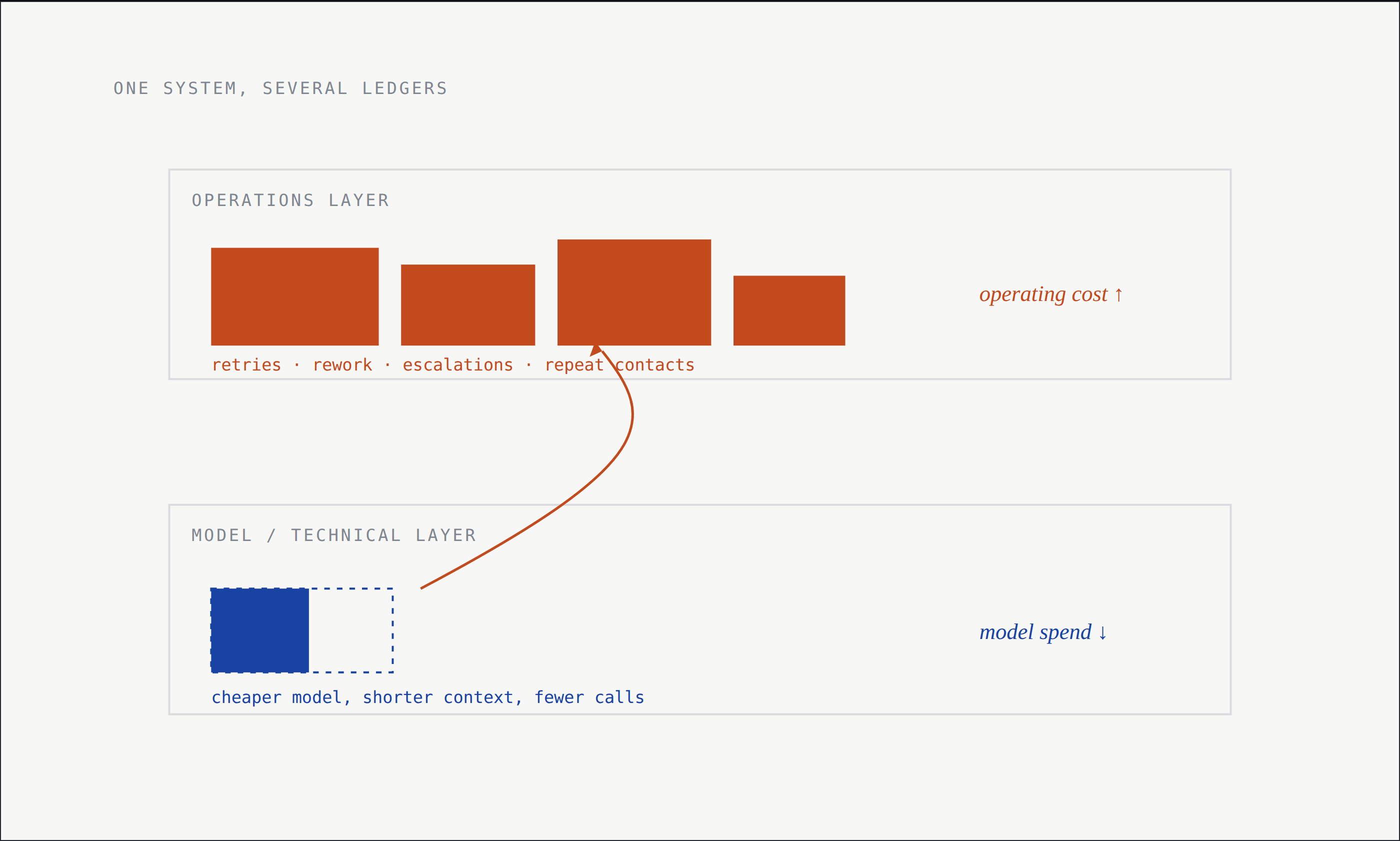
The missing cost did not disappear. It moved into retries, escalations, rework, repeat contacts, and unresolved customer issues. Those costs sit above the layer the team was asked to optimize.
The Displacement Law
This pattern is the Displacement Law:
Whatever rung you make the target, people optimize it and the failure surfaces one rung higher, where you were not looking.
Measure tokens and failure moves into task completion.
Measure tasks completed and failure can move into quality.
Measure quality and failure can move into business value, customer trust, compliance exposure, or downstream labor.
The dashboard remains green because the dashboard was designed around the target. The loss appears in a different system, owned by a different team, on a different reporting cycle.
Three things the saving can be
When a lower metric improves, one of three things has happened, and they need different responses.
The saving is real when the work genuinely got cheaper and nothing downstream degraded. Take it.
The saving is a transfer when the cost moved to another ledger: fewer tokens, more human review. The total did not improve; the reporting boundary did. Find the receiving team and read the two ledgers together.
The saving is destruction when value was lost rather than moved: a cheaper model that closes fewer cases and sends customers away. No one receives this cost as a line item. It leaves as attrition, risk, or lost trust.
Most dashboards cannot tell these apart, because all three look identical at the optimized rung. Only the metric one level up separates them.
Displacement also does not always move straight up. It can move sideways to another team at the same level, or forward in time, where a quarter-end saving becomes next quarter’s rework. A guardrail one rung higher catches the vertical case. The sideways and forward cases need someone watching the whole system, not just the next rung.
Why AI makes displacement sharper
Traditional software usually executes a predefined path. AI systems can retry, branch, call tools, escalate, and produce outputs of varying quality. A small design change can reduce visible model consumption while increasing invisible work elsewhere.
The organizational boundaries make this harder to see. The AI platform team reports the lower model bill. Operations absorbs more exceptions. Customer service handles repeat contacts. Risk reviews a larger sample. Finance sees a saving in one line and new labor pressure scattered across several others.
No single owner sees the move.
Put a guardrail one rung higher
Every optimization target needs a companion metric one rung above it.
If the target is cost per call, protect task-completion rate.
If the target is cost per completed task, protect verified success rate.
If the target is cost per successful outcome, protect the accepted business effect and any material risk measure.
This does not prevent optimization. It makes the trade visible while there is still time to respond.
A cost initiative should therefore state three things before the team acts:
The metric being improved
The higher-level metric that must stay healthy
The owner who will detect displacement
Without those, the organization is rewarding a local improvement and hoping the rest of the system absorbs the consequence quietly.
Local optimization still has a place
The Displacement Law does not mean every team must own the entire P&L before improving a model. Local optimization is necessary. Token efficiency, caching, prompt design, and routing can produce real savings.
The discipline is to make the boundary explicit. A platform team can own consumption efficiency while an operations owner protects completion and quality. The two measures should be reviewed together for material workflows. When the lower metric improves and the higher one deteriorates, the organization has found a transfer rather than a saving.
That distinction keeps teams moving while preventing a narrow target from becoming the whole definition of success.
The executive question
Before setting an AI target, ask:
Where will the failure go when the team hits this number?
It always goes somewhere.
A question for readers
Where have you seen a technology saving reappear as labor, quality, customer, or risk cost?
Onward,
Raja
Raja Pabba is the founder of CloudMetrics and writes The CAIO Review on enterprise AI operating discipline. Subscribe at caioreview.com.