

Put two Chief AI Officers from two companies in the same room and ask each to describe the job. One talks about the audit trail for the AI Act and who signs off before a model reaches a customer. The other talks about the three workflows being re-engineered this quarter and the margin they expect to move. Same title on the business card. Two jobs that barely touch.
I have sat in both conversations, and the distance between them is not a matter of style or seniority. It was set before either person was hired, by a decision the company made without noticing it was making one. The pressure that created the seat quietly defined the seat, and most of the time nobody said so out loud.
The last edition argued that the Chief AI Officer owns one thing: the return on the AI portfolio, defended in the language the CFO already uses. That is what the role should be. It also named two profiles circulating in the market, the strategy owner and the platform owner. In the field there are four, and this edition is about telling them apart. Knowing which one your company hired, or which one you have quietly become, is the difference between a mandate and a misunderstanding.
A role becomes whatever pressure created it
Three pressures are minting Chief AI Officers right now, and each one produces a recognizable type.
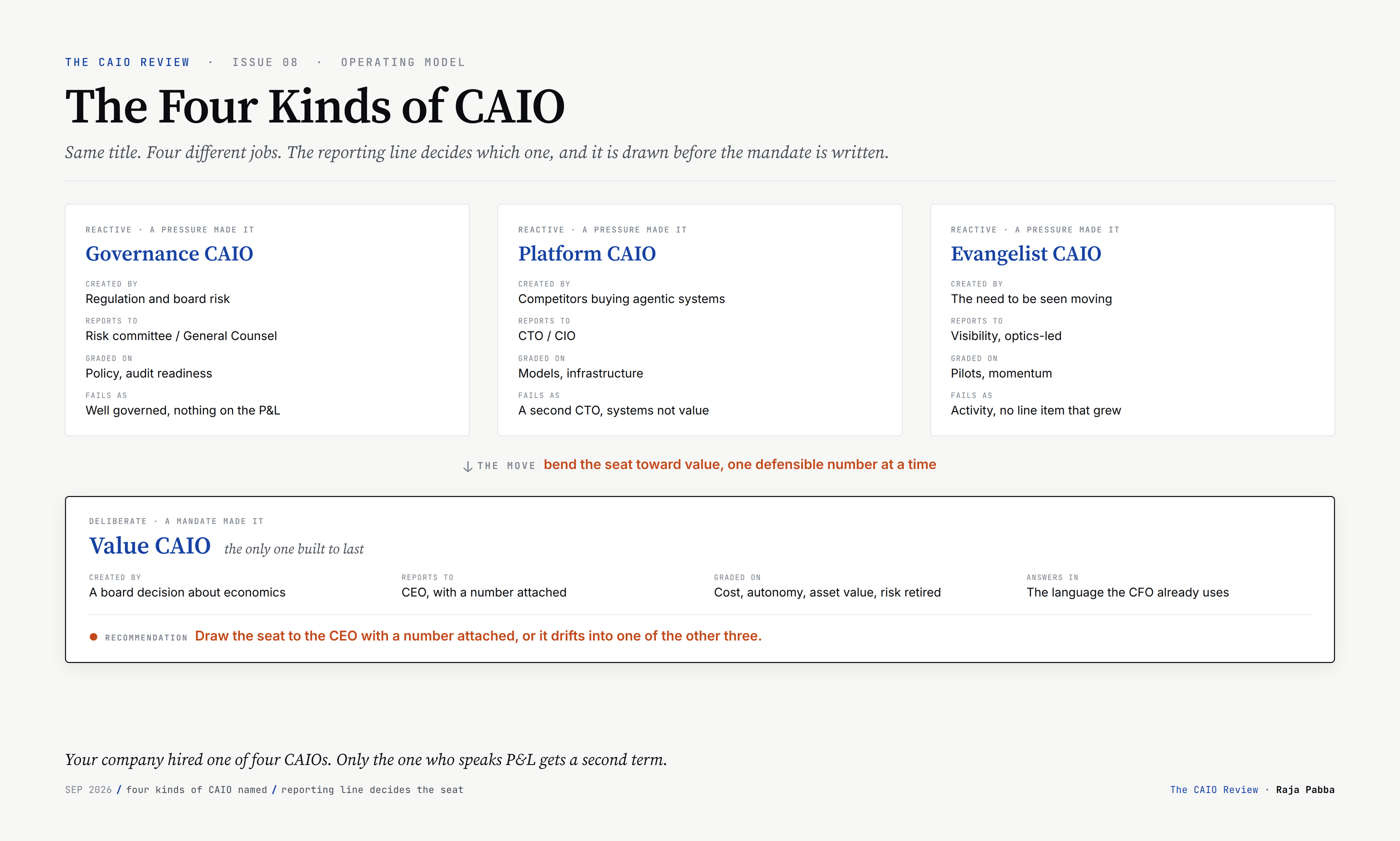
The Governance CAIO is created by regulation and board anxiety. The trigger is the AI Act’s first deadlines and a board that has started asking who answers when a model goes wrong. This CAIO owns policy, risk classification, and audit readiness. The work is real. The failure mode is that the seat comes to measure itself by what it documents, and a year in, the portfolio is well governed and has produced nothing anyone can carry to a P&L.
The Platform CAIO is created by competitive pressure. The trigger is rivals buying agentic systems and the fear of being left with a slower stack. This CAIO reports to the CTO or the CIO and owns models, infrastructure, and integration. The work is necessary. The failure mode is that the role settles into a second CTO with a newer title, accountable for systems rather than for value, and the two are not the same account.
The Evangelist CAIO is created by the need to be seen moving. The trigger is a board that wants visible momentum and a competitor’s press release. This CAIO runs demos, stands up pilots, and carries the internal roadshow. The work builds energy. The failure mode is the one this publication keeps naming: activity counted as progress, a stack of launched pilots and no line item that grew because of them.
The Value CAIO is the only one of the four that a mandate creates rather than a pressure. This CAIO reports to the CEO, owns the portfolio’s return, and answers in cost, autonomy, asset value, and risk retired. The trigger is a board that decided, on purpose, that someone should own the economics of AI the way the CFO owns the economics of the business. It is the rarest of the four and the only one built to last.
Reporting line decides it
Read this as four reporting lines and four scorecards, three of them assigned by accident. Temperament has little to do with it.
Reporting line tells you most of it. A CAIO who reports to the CTO gets graded on systems, because that is what the CTO is graded on. A CAIO who reports to the general counsel or the risk committee gets graded on exposure retired. A CAIO who reports to the CEO with a number attached is the only one whose scorecard points at value. Reporting line settles the archetype before anyone sits down to an interview, and the reporting line is usually drawn before the mandate is written.
This is why churn in the role runs so high, and why it echoes the Chief Digital Officer a decade ago. Companies hire the profile the loudest pressure calls for, then grade it against a mandate nobody agreed on. Someone is brought in as an Evangelist to create momentum and let go eighteen months later for not moving a P&L number that was never in their scorecard. The mismatch was built in on day one.
There is a maturity reading underneath this as well. The three reactive archetypes tend to appear at organizations still early on the readiness curve, where the substrate cannot yet carry value and the pressure to act outruns the ability to deliver it. The Value CAIO becomes possible only when the ground is ready to be measured. Which archetype a company can actually support is, in part, a diagnostic of how ready that company is.
Place the seat in five minutes
Two questions locate any Chief AI Officer.
First, who do they report to? That single line predicts the scorecard more reliably than the job description does. Second, what pressure triggered the hire? Regulation produces a Governor. Competition produces a Platform build. Optics produce an Evangelist. A board decision about economics produces a Value owner. Name the trigger honestly and you have named the archetype, whatever the offer letter said.
Then act on the answer. If you are appointing, decide which archetype the mandate needs before you draw the reporting line, and draw the line to match. If governance is the real need, say so, and do not grade the hire on EBITDA. If value is the need, the seat reports to the CEO with a number attached, or it drifts into one of the other three by gravity.
If you are already in the chair and the two questions place you in a reactive archetype, the move is to bend the seat toward value on purpose. Take one workflow, quote its cost of work, and report the result in the terms the CFO already uses. Nobody reassigns you to the Value archetype. You report your way into it, one defensible number at a time.
Seventy-six percent of large companies now have a Chief AI Officer, and most of them hired one of the first three archetypes without meaning to. The board’s job is to know which one, and to say so. Your company hired one of four CAIOs. Only the one who speaks P&L gets a second term.
One question for your next leadership meeting. If you named the pressure that created your Chief AI Officer role, and then named the scorecard that role is graded on, would the two point in the same direction? Where they diverge is where the next eighteen months of friction already lives.
Onward,
Raja