

An AI pilot is usually designed to make the capability visible. Its economics remain outside the frame.
The cases are selected. The scope is bounded. Engineers watch every run. Human support is donated. Evaluation is occasional. Production controls have not arrived.
Then the pilot succeeds and quietly becomes a service.
That boundary is where the cost model changes.
Why the pilot looks inexpensive
A pilot receives several structural subsidies.
First, volume is small and often curated. The team can avoid the hardest edge cases and investigate failures manually.
Second, attention is free. Engineers, product leaders, and subject-matter experts absorb exception handling as part of the experiment. Their time rarely appears in the pilot cost.
Third, the success standard is forgiving. A pilot can be “promising” while production must meet an operating threshold every day.
Fourth, production infrastructure is absent or incomplete. Monitoring, access controls, audit trails, support coverage, resilience, and incident response arrive later.
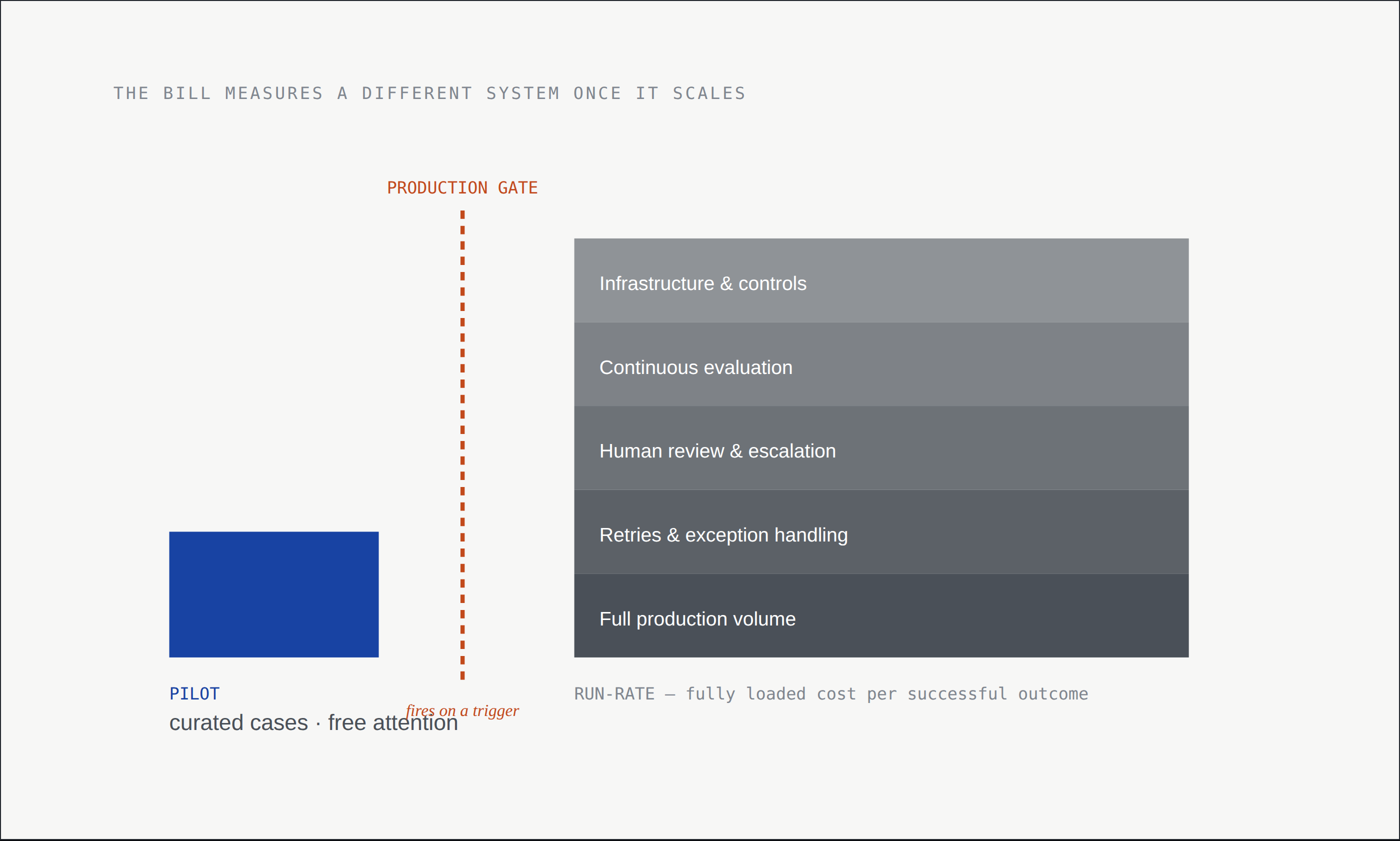
The pilot bill therefore measures a different system from the one the company is about to fund.
Five costs enter at the boundary
When the pilot crosses into run-rate, five cost categories usually expand or appear:
Full production volume across normal cases, peaks, and seasonality
Retries and exception handling when the model or workflow fails
Human review and escalation for cases automation cannot close
Continuous evaluation and monitoring as models, data, and behavior change
Production infrastructure and controls required for a standing service
The naive forecast multiplies pilot token cost by expected production volume.
The credible forecast rebuilds the fully loaded cost per successful outcome with the production stack included.
The silent transition
The riskiest transition is the one nobody declares.
A temporary experiment acquires permanent users. Business teams begin to depend on it. A service expectation forms. The invoice grows each month. Yet no one returns to the investment case because the project never formally “launched.”
The organization discovers the run-rate through budget variance.
At that point the program is difficult to stop. Users have changed their workflow, leaders have announced success, and the pilot sponsor has become the de facto service owner.
The solution is to make the boundary an explicit operating decision.
Because no one reliably declares that boundary, the gate should fire on a trigger rather than on someone’s sense that a launch has happened. Set the trigger in advance: a monthly invoice above a threshold, a count of active users, a share of production traffic, or a volume of real cases served. When the workflow crosses the line, the reforecast is required before spend continues. That turns the silent transition into an event the organization cannot miss.
The production gate
Before an AI pilot receives permanent volume, require a one-page reforecast:
What changes at full volume?
Which costs were subsidized or omitted during the pilot?
What success rate will production be held to?
What are the expected retry, review, and escalation rates?
What is the forecast fully loaded cost per successful outcome?
Which assumptions trigger a reforecast?
Who accepts the standing run-rate?
This gate should be fast. Its job is to expose the economic change, not to reopen the entire technical design.
The most useful comparison is not pilot spend versus production spend. It is pilot cost per successful outcome versus expected production cost per successful outcome. That distinction separates healthy scale from an expensive expansion of failure.
Scale can improve the economics
The production boundary is not automatically a cost disaster. Volume can improve utilization, justify better routing, spread fixed platform cost, and produce enough data to reduce failure rates.
That possibility strengthens the case for a gate. The point is to model the change rather than assume a simple multiplier. A credible reforecast should show both pressures: costs that appear at production and efficiencies that become available only at scale.
If the forecast includes only the cliff, it is pessimism. If it includes only the volume multiplier, it is pilot theater. The decision needs both.
The executive question
A successful demo answers, “Can this work?”
The production gate answers, “What will it cost when the organization depends on it?”
Both answers are required before the pilot becomes a permanent line item.
A question for readers
Which cost surprised you most when an AI pilot moved into production?
Onward,
Raja
Raja Pabba is the founder of CloudMetrics and writes The CAIO Review on enterprise AI operating discipline. Subscribe at caioreview.com.