

If I inherited AI cost governance tomorrow, I would resist the urge to begin with a policy or a software purchase.
I would start with a baseline.
Most organizations already have parts of the answer. Finance has invoices. Engineering has token and call data. Product has workflow telemetry. Operations knows where people repair the output. Business leaders know which outcomes matter.
The problem is that the evidence sits in separate ledgers.
The first 90 days should connect those ledgers in the order that makes each next decision possible.
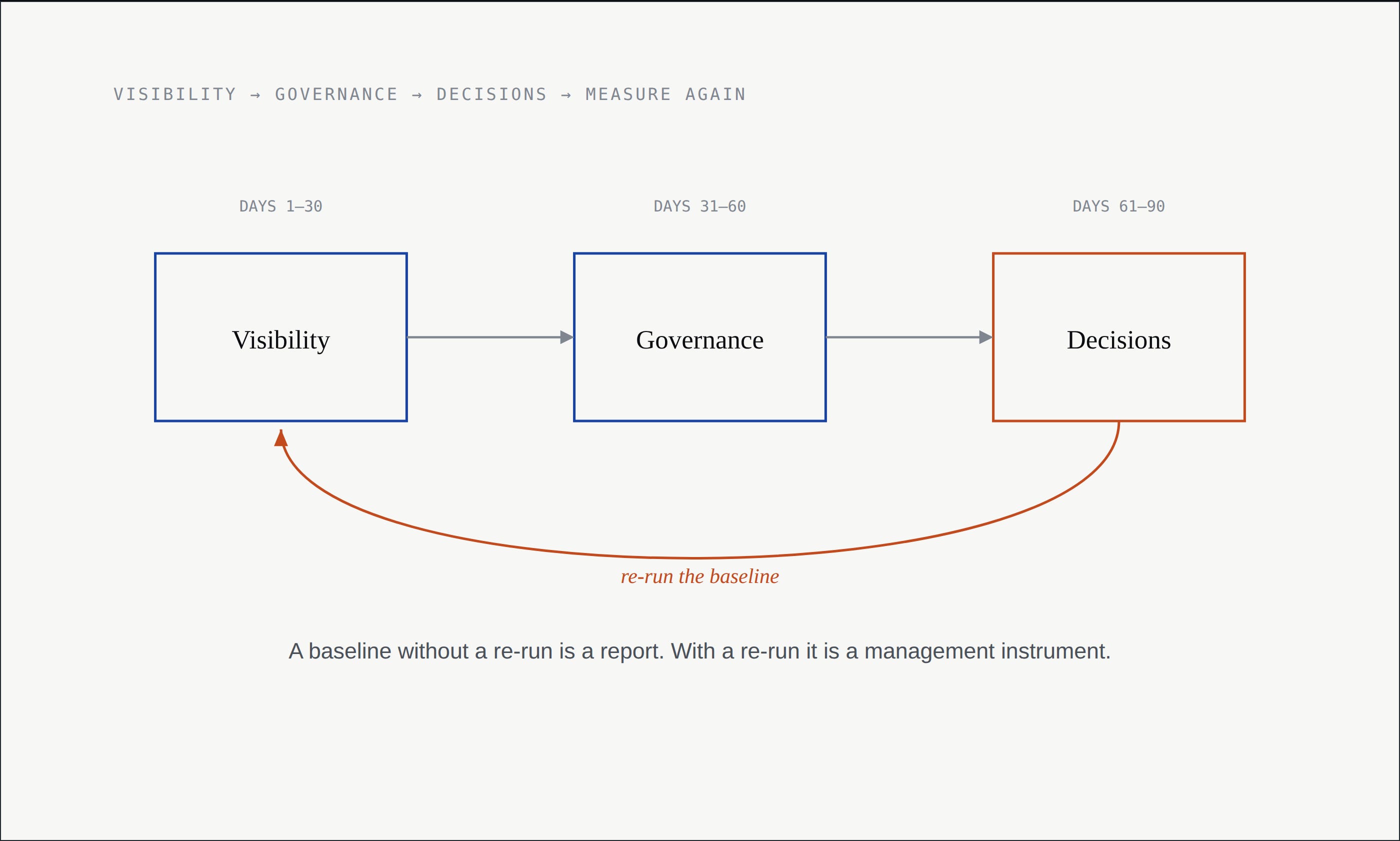
Days 1–30: Visibility
Choose the few workflows responsible for most material AI spend or business consequence. A portfolio-wide inventory can come later.
For each selected workflow:
Build the fully loaded cost stack, including model, platform, data, evaluation, human review, and operating support.
Define the unit of work in a sentence the process owner recognizes.
Count attempts, completions, failures, retries, and escalations.
Write the Success Signature for the outcome.
Establish the first cost-per-successful-outcome baseline.
Some inputs will be estimated. Label them. The purpose of the first month is not false precision. It is to expose which layers are visible and which are carrying the business case without evidence.
The deliverable is one page for the top workflows: what each costs, what work it performs, what outcome it produces, and which parts remain uncertain.
Days 31–60: Governance
With the baseline visible, put ownership around it.
Attribute each material dollar to a workflow and named owner. Where cost is shared, document the allocation method and the person authorized to resolve disputes.
Start showback. Put fully loaded cost, successful outcomes, cost per outcome, trend, and exceptions on the same page.
Assign decision rights:
Who can change model or routing?
Who can change the workflow?
Who owns the budget?
Who defines successful?
Who accepts the outcome verdict?
Then establish a lightweight governance loop:
Attribute → Explain → Optimize → Reallocate
The meeting should end in a decision rather than a report. Explain why a ratio moved, select the next intervention, and name the owner and review date.
Days 61–90: Decisions
Now optimize the workflows with enough evidence to support action.
Run the AI Minimalism Ladder. Confirm that each workflow uses the smallest reliable mechanism that can meet the outcome.
Revisit model selection and placement. A cheaper model may reduce unit cost, or it may create retries and human escalation. Compare on fully loaded cost per successful outcome.
Remove genuine waste while protecting efficient high-value work. Reallocate budget based on the economics rather than total spend.
Re-run the baseline. Which blind layers closed? Which ratios moved? Which assumptions remain? Where did failure get displaced?
The second reading matters more than the first. A baseline without a re-run becomes a report. A baseline with a re-run becomes a management instrument.
What “done” looks like
At day 90, a perfect dashboard is unnecessary.
The organization should have:
A defined unit of work for the material workflows
A Success Signature for each outcome
A fully loaded cost baseline
Named owners and decision rights
Outcome-weighted showback
A standing review cadence
At least one measured intervention and re-run
Most important, it should have a working loop:
See the cost. Tie it to work. Verify the outcome. Make a decision. Measure again.
That is enough to stop managing AI as an invoice and begin managing the economics of the work.
The next step
The diagnostic behind this sequence is TRACE: a point-in-time read of where the organization can measure, where it claims to manage, and where the two ledgers fail to reconcile.
The natural companion to this article is one asset, not several. Choose one:
A downloadable 90-day checklist
A sample one-page baseline
The opening chapter of The AI Cost Playbook
An invitation to run a TRACE diagnostic
Give the reader one clear next move.
A question for readers
If you had 90 days to improve AI cost governance, which would be hardest: visibility, attribution, outcome definition, ownership, or reallocation?
Onward,
Raja
Raja Pabba is the founder of CloudMetrics and writes The CAIO Review on enterprise AI operating discipline. Subscribe at caioreview.com.