

One AI initiative creates three financial decisions.
Most organizations collapse them into one monthly review. The team shows spend against budget, usage against forecast, and a few operating highlights. Leadership leaves believing it has reviewed the investment.
It has usually reviewed only the middle question.
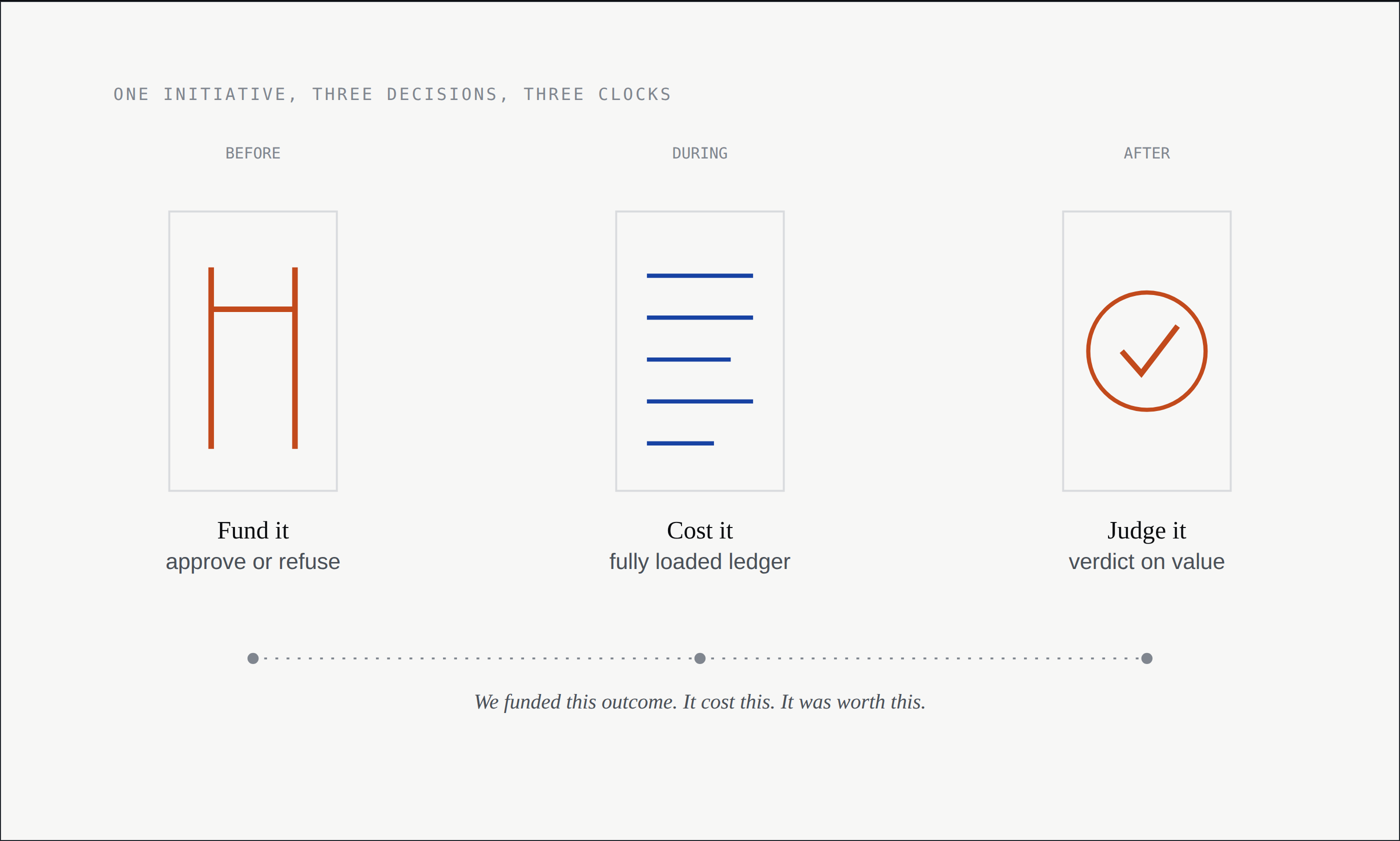
Fund it
Funding is the pre-spend decision.
What are we buying? Which business outcome is expected? What uncertainty are we accepting? What evidence would justify the next tranche of capital?
The funding case should name the outcome rather than the capability. “Build an AI support platform” describes an asset. “Reduce the fully loaded cost of verified ticket resolution while maintaining customer outcomes” describes an investment thesis.
The owner is the person willing to refuse the investment when the expected outcome does not justify the capital.
Cost it
Costing is the operating ledger.
What did the initiative consume, fully loaded? The answer includes more than the model invoice:
Model and platform consumption
Data preparation and integration
Evaluation and monitoring
Human review and escalation
Operations, support, and change cost
Embedded AI charges inside other software
This is the question organizations answer best because invoices exist and finance processes already know how to collect them.
Necessary discipline can still become false confidence. Knowing the cost precisely does not reveal whether the investment was wise.
Judge it
Judging is the outcome verdict.
Did the work produce the agreed result? Was the result economically better? Should the organization expand, redesign, hold, or stop?
The verdict arrives after the initiative has produced observable outcomes. It requires a definition of success, a baseline, and a named P&L destination.
The owner should be close enough to the business effect to accept or reject the claim. In many organizations that is a business or operational leader, with finance validating the economics.
Why the separation matters
An initiative can remain within budget and still be a poor investment. It can deliver every technical milestone and fail to create a valuable outcome.
An initiative can also exceed its original budget and still deserve additional funding because its verified outcomes are worth more than expected.
“What did it cost?” cannot answer “Was it worth it?”
The confusion persists when all three acts belong vaguely to “the AI program.” The program team prepares the business case, reports the spend, defines success, and declares the result. Accountability becomes circular.
Put three names on the page
For every material AI initiative, record:
Funding owner: Who approves or refuses the investment?
Cost owner: Who maintains the fully loaded operating ledger?
Outcome owner: Who delivers the verdict on business effect?
The same person can hold more than one role in a smaller organization. The questions still need separate answers.
The three views should meet in a reconciliation statement: We funded this outcome, the initiative cost this amount, and the verified result was worth this much under the agreed method.
That sentence is more useful than a green budget variance.
Give each act its own cadence
The three acts should not wait for the same monthly meeting.
Funding decisions belong at investment gates and material scope changes. Costing belongs on an operating cadence, often monthly and more frequently for volatile workloads. Judging belongs when enough outcome evidence exists to support a verdict.
Forcing all three onto one calendar creates predictable errors. Teams judge too early using activity because outcomes have not matured, or they continue funding long after the evidence is strong enough to stop. Separate clocks make the review more decisive.
A question for readers
Which of the three acts is least clearly owned in your organization: funding, costing, or judging?
Onward,
Raja
Raja Pabba is the founder of CloudMetrics and writes The CAIO Review on enterprise AI operating discipline. Subscribe at caioreview.com.