

Cost per successful outcome sounds like the right AI metric. It is also incomplete until someone defines successful.
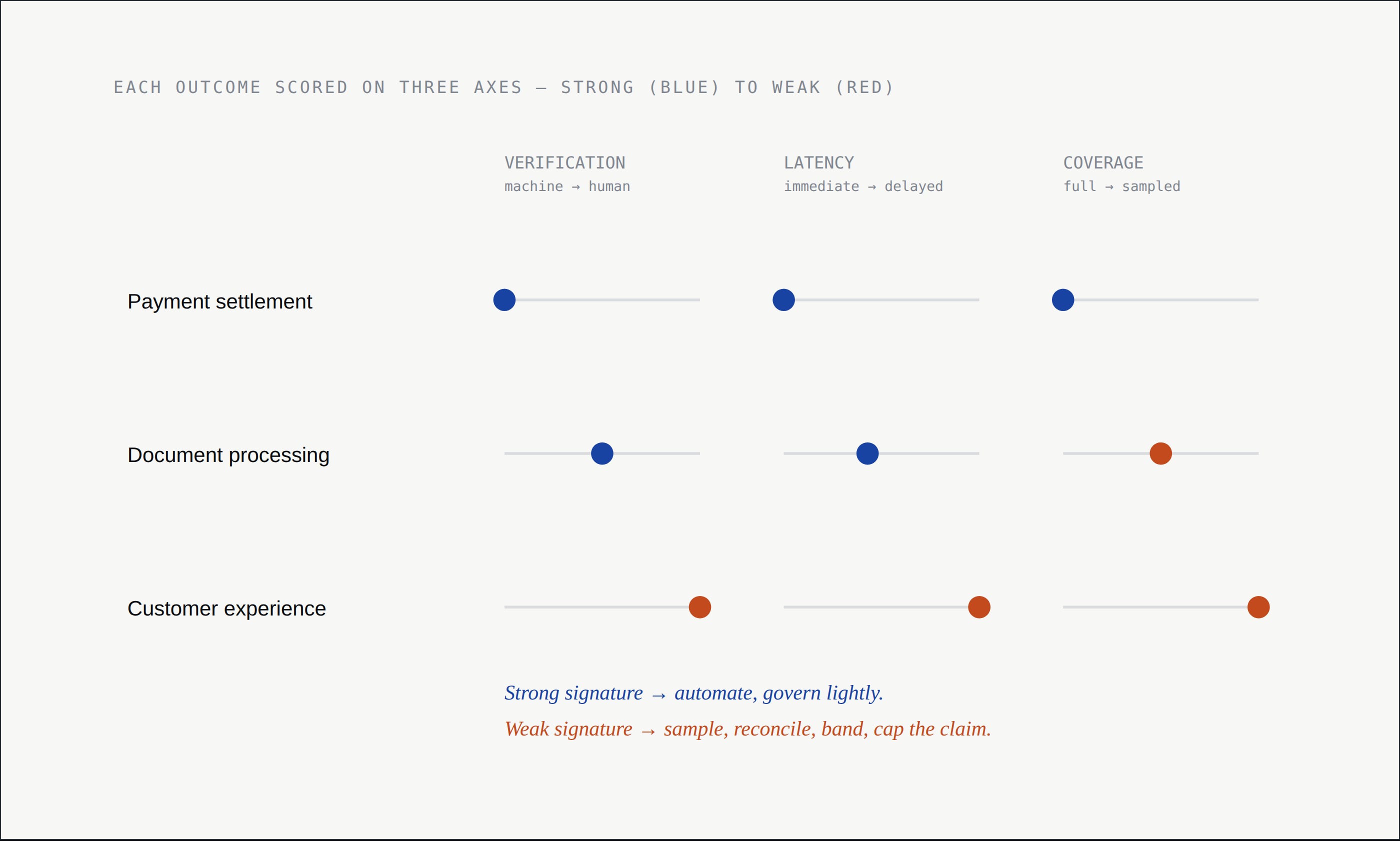
A payment either settles or it does not. A machine confirms the result within milliseconds across every transaction.
A satisfied customer is harder to prove. The signal may arrive days later through a survey completed by a self-selected fraction of customers.
Both teams can report a success rate. The confidence behind those rates is completely different.
The denominator carries the argument
Most cost discussions scrutinize the numerator. Teams debate token prices, cloud allocations, labor rates, platform fees, and shared infrastructure.
The denominator often receives one sentence: tickets resolved, claims processed, customers helped.
That is where the economic argument can quietly fail.
Was the ticket actually resolved, or merely closed? Was the claim processed correctly, or did it return as an exception? Was the customer helped, or did the interaction simply end?
Every cost-per-outcome metric contains a definition of success, whether the team has written it down or not.
The Success Signature
Before using an outcome as a denominator, give it a Success Signature across three dimensions.
1. Verification
Who or what confirms that the outcome happened?
Machine verification is usually consistent and inexpensive. Human verification can capture judgment that a system cannot, but it introduces cost, variation, and sampling choices.
2. Latency
How long until the organization knows whether the outcome held?
Some outcomes are known immediately. Others require days or months. A recommendation may appear sound when issued and prove weak only after a downstream event.
3. Coverage
How much of the outcome stream can the organization observe?
Payment settlement may offer full coverage. Customer satisfaction often relies on a sample. The smaller and more selective the sample, the more carefully leaders should interpret the resulting cost metric.
The signature changes the control
A machine-verified, immediate, fully covered outcome can support faster automation and lighter controls. The truth is available quickly and gaming has less room to hide.
A human-judged, delayed, sampled outcome requires a different posture. The organization may need audit samples, reconciliation windows, confidence ranges, and explicit limits on what the number can support.
This is why a single governance policy rarely fits every AI workflow. The control should reflect how well the outcome can be seen.
A weak signature is not only less certain. It is more manipulable. When verification is human, delayed, and sampled, the team being measured has room to influence the number: close tickets that were not resolved, mark ambiguous cases as successes, or rely on the fraction of outcomes the sample happens to catch. The weaker the signature, the more the definition of success should belong to someone other than the team whose performance it scores.
The mapping is direct. A strong signature earns automation, a light control, and a number leadership can act on quickly. A weak signature earns a sampled audit, a reconciliation cadence, a reported range instead of a point, and an explicit ceiling on what the number is allowed to claim.
A practical exercise
Choose the three AI workflows receiving the most investment. Write one sentence defining a successful outcome for each. Then record:
Verification: machine, human, or mixed
Latency: immediate, days, weeks, or longer
Coverage: full population or sample
If the team cannot complete the first sentence, cost per successful outcome is premature. If it can complete the sentence but the signature is weak, the metric should be presented with an explicit confidence boundary.
The denominator deserves the same diligence as the spend.
When full verification is impossible
Some valuable outcomes will never be perfectly measurable. That does not disqualify them. It changes how the organization should use the number.
A sampled or delayed outcome can still support a decision when the sampling method is stable, the uncertainty is visible, and leaders avoid false precision. Report a range where a point estimate would overstate confidence. Track whether the sample is changing. Reconcile a subset against deeper human review on a cadence.
The aim is not perfect measurement. It is an honest account of what the measurement can and cannot prove.
That boundary is a governance input.
A success metric without a signature is an opinion with decimal places.
A question for readers
Which outcome in your AI portfolio is hardest to verify honestly?
Onward,
Raja
Raja Pabba is the founder of CloudMetrics and writes The CAIO Review on enterprise AI operating discipline. Subscribe at caioreview.com.